Monday, January 1, 2018

My wish for 2018: That history will matter again

“This will be final message from Saigon station. It has been a long fight and we have lost. . . . Those who fail to learn from history are forced to repeat it. Let us hope that we will not have another Vietnam experience and that we have learned our lesson. Saigon signing off.”

As we sign off from 2017 and look ahead to 2018, it would be wise to recall these words from Thomas Poglar, the CIA station chief who uttered America's last pronouncement from the Vietnam War as Saigon fell in April 1975. If the last couple years has taught me one thing, it's how little most Americans, particularly those who wield the greatest power today, seem know, or choose to learn, from history. And more than anything, it explains why so many choose to cling to elements of the past that should represent shame, while ignoring the elements that represent the most significant steps toward progress and justice that our democracy should symbolize.


And lest you think this is simply another attack on the unpresidential conduct of our current commander in chief, let me assure you that the inability, or unwillingness, to learn from history is not limited to any one ideology, but indeed is endemic to extremists on both the left and the right who dismiss facts and truth in pursuit of their own arrogant and misguided vision for our country, and the world.

Here's a quick rundown of where history lost in 2017, followed by a hope that 2018 will finally prompt most Americans to look to the past for real and meaningful guidance to the future.

1) The President of the United States chose to honor Native American code breakers from World War II by standing in front of a portrait of a president (Andrew Jackson) who committed probably the greatest genocide against Native Americans (the Trail of Tears) in American history. If that weren't enough, he capped the ridiculous display with a racist, Native American-themed slur against a political opponent.
2) Speaking of Andrew Jackson, Trump has made no secret of his infatuation with the occupant of the $20 bill and his desire to mold his "populist" presidency after our seventh president, who apparently best represented American greatness. Of course, any reading of history tells us that Andrew Jackson's vision of greatness was a country in which white males trampled over the basic rights of other Americans, most notably African-Americans and Native Americans, and matters of life and death and morality were inconsequential to the greater cause of seeing the United States expand its territory and power over all who would dare stand in its way. Jackson was the most staunchly pro-slavery president in early American history, and his unwillingness, or lack of interest, in confronting the insidious evil that was beginning to split the nation during his presidency ultimately led to the Civil War. In fairness, Jackson was a man of his times, and some of his actions did advance the principles of democracy and equality of opportunity, but in the era in which he presided, those principles were only relevant to white males, and for Donald Trump or anyone else to ignore that fact is to betray history.
3) Moving to the liberal end of the ideological spectrum, a recent survey indicated that half of Millennials say they wouldn't mind living in a communist or socialist country. This follows the shameful and pathetic praise that was heaped upon Cuban dictator Fidel Castro by some on the left (including Canadian Prime Minister Justin Trudeau) upon Castro's death in late 2016. Trudeau was richly, and deservedly, mocked over his comments, in which he called Castro "a remarkable leader." Indeed, Castro was remarkable -- remarkable at destroying lives, murdering innocent people, turning his country into an economic backwater of despair, plunging the world to the brink of nuclear war and representing all that was evil and destructive about the communist system during the Cold War. The fact that so many young people have such a sanguine view of communism today is yet another example of how little younger generations know, or care, about the lessons of history. No system in world history has done more to trample on basic human rights than communism; no system in world history has proven to be such an economic and moral disaster than communism; no system in world history has done more to threaten world peace, and human survival, than communism. History has already passed its judgment on communism; sadly, many Millennials seem eager to give it another chance. Since it would surely be too much to ask them to commit 18 hours of their time to watching Ken Burns' "Vietnam War," perhaps they can squeeze the final 2-hour episode which covers what happened to the people of Vietnam when communism "won."
4) The fact the #MeToo movement exploded onto the national scene at the end of 2016 shows how little was learned by the feminist movement of the 1960s and '70s and decades-long push for gender equality. The fact that so many men in positions of power continued to think they were entitled to treat women as sexual objects long after such behavior should have been stigmatized and universally condemned shows how little we have learned the lessons of the long fight for civil rights in this nation.
5) Anyone who watched the "Vietnam War" series, or any documentary about war, or read "All Quiet on the Western Front" or any novel about war, appreciates the common thread of war through history: It is unquestionably, undeniably, horrible for all involved. It's not something to be taken lightly, joked about, or casually tweeted about. The United States is at its greatest when it does everything in its power to find peaceful solutions to the world's problems, not when its president threatens to "totally destroy" nations with nuclear weapons in front of the United Nations, the world body that was established precisely to prevent the horrors of world war that consumed the planet in the 20th century.

Perhaps fittingly, 2017 ended with a White House ceremony to mark the signing  of the Republicans' tax bill, a piece of legislation that marked a betrayal of history by promising economic prosperity by cutting taxes and freeing the hand of corporations and the wealthy (the same promises that led to the Great Depression and Great Recession when unbridled faith in capitalism led to economic disaster). But I think the greatest betrayal of history in 2017 came out of the mouth of Senator Orrin Hatch during that ceremony, where he speculated that perhaps the most ill-informed, untruthful, crude, disrespectful and divisive president in American history may ultimately go down in history as its greatest. Those words were spoken a short distance from the Lincoln Memorial, in which history honors a man who was the polar opposite of Donald Trump in every way imaginable, a man who represented grace, humility, dignity and strength unsurpassed in American history, a man who summoned Americans to reach for the "better angels" of their nature and to bind up the nation's wounds at its hour of greatest peril and tragedy. Abraham Lincoln represents both everything we should learn from history, and everything Americans have chosen to forget.

Orrin Hatch should rest assured that whatever becomes of the Trump presidency, the words inscribed in the Lincoln Memorial will never be spoken about Donald Trump or himself:

"In this temple, as in the hearts of the American people for whom he saved the union, the memory of Abraham Lincoln lives forever."


Whatever the future holds in 2018 and beyond, America's hope for achieving true greatness will ultimately hinge on the ability and willingness to learn the lessons from its past -- both from its achievements and its sins.  That was the message from Thomas Poglar as he signed off from Saigon in 1975, and, more than ever, it needs to be the message today.

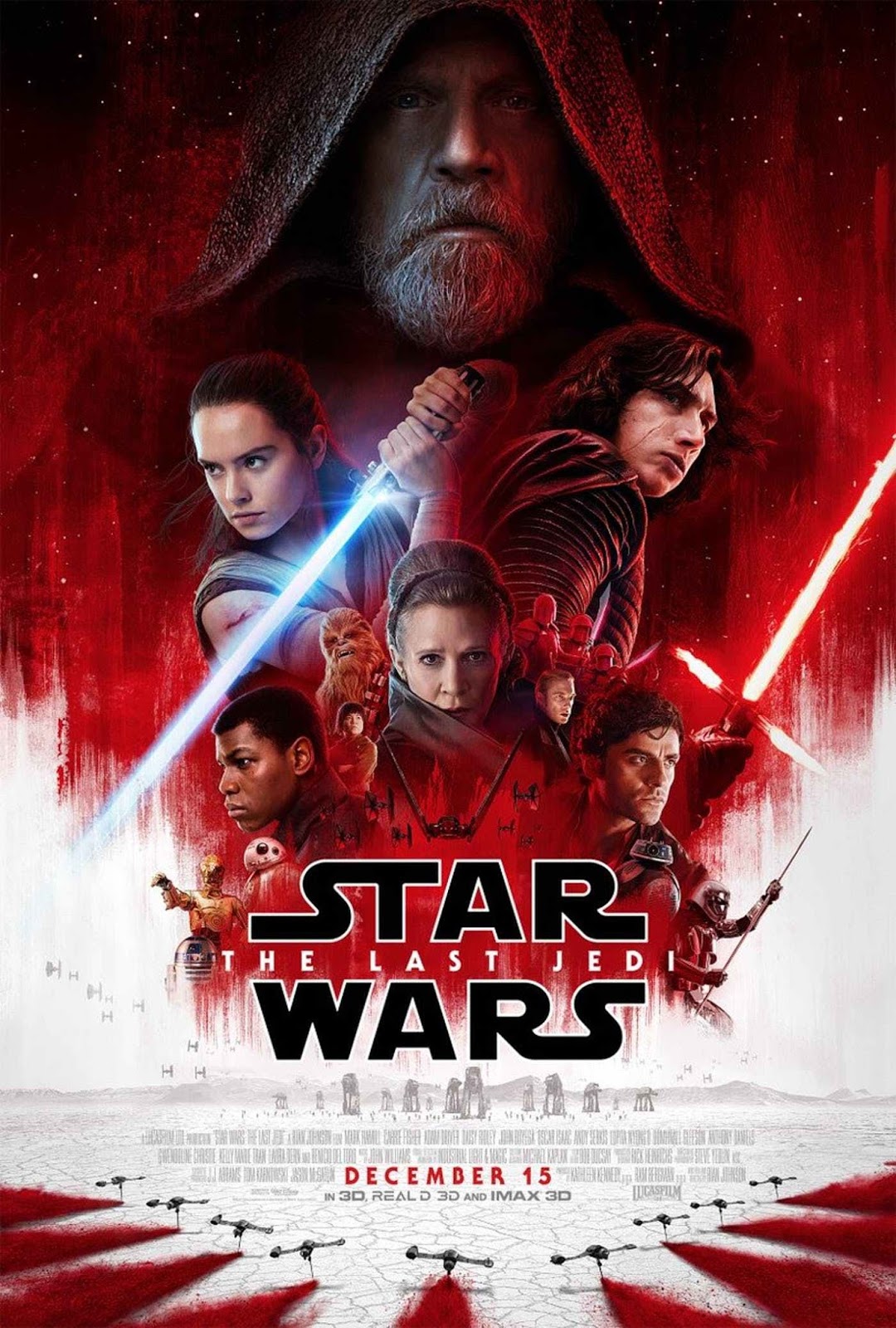


Sunday, December 17, 2017

"The Last Jedi": A flawed thrill ride that falls short of greatnesss

Update 03/28: Since this post, I have seen the movie a second time and changed some of my views of the film. This is from a post on my Facebook page:
I finally made it to a second viewing of "The Last Jedi" yesterday. The fact Todd PerlmanChris Treadway and I were the only three people in the theater for the matinee made for a somewhat surreal experience.
I have to say I enjoyed it much more the second time around, and that I was a little too harsh in my initial critiques (I fell victim to hyper-analyzing the story lines and underlying plot of the movie). Knowing exactly how the story would unfold, I was able to enjoy the movie on its own terms, and appreciate the wonderful cinematography, special effects and even top-notch acting and narrative. It has a beautiful flow and pacing, and I now think it ranks among the greatest in the franchise.

Channeling all my fellow Star Wars nerds. Here's my review of "The Last Jedi" (trying not provide spoilers, but if you haven't seen it, read at your own risk).
Overall, the movie had its moments and provided some nice twists and turns that kept me guessing and entertained for all of the nearly three hours, but I also thought it had some significant flaws. In my mind, it doesn't come close to measuring up with "A New Hope" or "The Empire Strikes Back," as some critics are suggesting, and is a notch or two below "Force Awakens" and "Rogue One" (the latter of which I think is the best movie since the original trilogy). "Last Jedi" is more on par with "Return of the Jedi," a Star Wars movie that was more entertaining than enriching or thought-provoking.
Here's a rundown of what I thought worked best:
1) Daisy Ridley gave another standout performance as Rey. She brings a depth and complexity of character to the story that was sorely missing from the whiny, brooding Anakin Skywalker of the prequels, and I thought she largely carried the movie.
2) The movie plumbed new spiritual depths in the Star Wars franchise, which for the most part worked well (though The Force is being stretched to dimensions that now truly require a leap of faith). The manner in which the movie explored failure as a pathway to spiritual and personal growth was a nice new element, and the brief return of Yoda was a definite surprise and highlight.
3) I thoroughly enjoyed the last 30 minutes, particularly the nostalgic nod to "Empire Strikes Back." The Rey-Kylo-Snoke confrontation featured some impressive twists and turns, plus a thrilling lightsabre duel, though I felt it mirrored a little too closely the Luke-Vader-Palpatine dynamic from "Return of the Jedi," particularly where it comes to the flawed arrogance of Snoke and Palpatine.
But there was plenty about the movie that I thought fell short of the mark:
1) It fell victim in places to the main problem of the prequels, in that action sequences and special effects got in the way of developing the deeper story. The movie lacked the pacing that marks the best movies in the franchise (particularly "Empire Strikes Back"), in which thrilling action sequences are interspersed with quieter moments that allow the characters to grow, develop and build relationships. In "Last Jedi," it felt like the opening battle never really ended. The sequences between Luke and Rey on the island seemed rushed and clunky at times, and lacked the smooth flow of the dual story lines that worked so well in "Empire Strikes Back," where each scene moved the story and characters forward in significant ways.
2) The dialogue was largely flat (George Lucas could have written some of those lines) and the humor, which always plays an underappreciated but vital role in the best Star Wars films, seemed forced. See-Threepio is being wasted in these movies, and the movie definitely suffered in comparison with "The Force Awakens" by the loss of Harrison Ford's Han Solo, whose sarcastic wit gave that movie the spunk that marked the original trilogy and was painfully absent from the stuffy prequels. Without Solo, this movie drifted back toward a degree of stuffiness. The light-hearted touch that new characters brought to last year's "Rogue One" was missing here.
3) While Rey shined, and Kylo Ren and Leia (in Carrie Fisher's final role) also had some memorable moments, many of the other characters were either annoying, boring or lacked any real development as the story progressed. Po Dameron was the worst, coming across as a shallow, impetuous, hot head whose miscalculations probably kill as many innocent people in this movie as anyone. Finn remains basically in the same mode of "Force Awakens," and his new sidekick brought nothing of interest to the movie for me (I found the whole plot line of their journey to the casino planet to find a master code-breaker a waste of time that in the end had no significance for the arc of the story, other than to introduce a young kid who seems destined to become a hero in future movies). Mark Hamill couldn't bring to his role what Harrison Ford brought to Han Solo last time around, and he really didn't capture the elder statesman-like gravitas of Alec Guinesses' Obi-Wan Kenobi, though he rose to the occasion as well as could be expected at the end. And the overarching First Order vs. Resistance plot left much to be desired (a slow-motion, three-hour siege that really took the story nowhere important).
4) The movie's handling of Grand Leader Snoke was a disappointment, and seems to leave little hope for more insight into his character. If George Lucas' fatal flaw with the prequels was his insistence on explaining everything in minute detail (including interstellar trade policies), one problem with this trilogy is that it's leaving a bit too much to the imagination.
In fairness, this might have been the most challenging movie in the series to execute, given the many unanswered questions and competing character narratives from both "The Force Awakens" and the original trilogy. To produce a sequel that truly matched "The Empire Strikes Back" in scope and grandeur was a monumental task. While this was an infinitely more satisfying second installment than "Attack of the Clones" from the prequels (which I rank as far and away the worst Star Wars movie ever), I wish it would have come closer to reaching the heights of Empire, which remains No. 1 for me (though last year's "Rogue One" is a close second).


My ranking of all nine Star Wars movies:
1. The Empire Strikes Back
2. Rogue One
3. A New Hope
4. The Force Awakens
5. The Last Jedi
6. Return of the Jedi
7. Revenge of the Sith
8. The Phantom Menace
9. Attack of the Clones


Sunday, December 3, 2017

What history has to say about tax cuts and trickle down economics

The Republicans' embrace of a mammoth tax cuts for corporations and the wealthy -- and their tired arguments that they will pay for themselves by sparking economic growth -- shows once again how little our elected leaders, and the people who elect them, understand, or care, about history.
We've heard this story many times before, and it rarely seems to end well. You know the line: If only we put more money into the hands of corporations and individuals -- particularly those who are already swimming in it -- and loosen the regulations stifling free enterprise, unfettered capitalism will handle the rest. The wealthy will spend, corporations will invest and hire, and profits generated as a result will trickle down for all to enjoy.
If only it worked out that way in reality. This was the mantra embraced by Republicans as far back as the 1920s -- when they controlled the levers of government as they do today -- and what did Americans get as a result? An unprecedented economic collapse and the Great Depression.

Fifty years later, Ronald Reagan came along and promised much of the same. He got his big tax cuts early in his administration, and sure enough, the long-slumping economy soon enough turned around. Vindication, right? Not quite. For one thing, the economic ills of the 1970s and early 1980s largely boiled down to the unique problem of stagflation -- a stagnant economy and runaway inflation -- rather than tax rates. Most economists credit the Federal Reserve's high interest rate policy -- not Reagan's tax cuts -- that finally snuffed out inflation and lit a fire under the economy. As for the tax cuts, far from trickling down to the masses, they helped lead to the massive income inequality we see today, never came close to paying for themselves, and ultimately blew a hole in the deficit that forced both Reagan and George H.W. Bush to enact tax increases.
Of course, the flip side of the Republican argument that tax cuts for those at the top unleash economic growth is that tax hikes on those at the top stunt growth and deter investment. At least, that's what they promised would happen after Bill Clinton hiked taxes in the early 1990s to address the growing deficit. The result? One of the greatest economic booms of the 20th century. Go figure.
But the clear evidence that the Republican tax mantra was not supported by any real evidence didn't stop George W. Bush from clinging to it yet again when he took office in 2001. With the economy finally slowing after years of stunning growth, Bush and the Republicans turned to -- you guessed it --- tax cuts as the answer. Those cuts were coupled with trillions of dollars spent on wars in Afghanistan and Iraq (after all, it's soldiers, not taxpayers, who should have to sacrifice in time of war), again blowing a hole in the deficit, and a general attitude toward letting Wall Street and the financial industry do whatever they want (because, after all, that thirst for profit will ultimately trickle down to the rest of us; as the 1980s taught us, "Greed is good."). With Republicans again in total control of government for much of the early 2000s (as they were in the 1920s), they stuck to the old playbook of low taxes, loose money and little regulation. We also know how that story ended, much as it did the first time around. We got the Great Recession, which easily could have been another depression if not for Barack Obama's shrewd stewardship of the crisis, for which he got unbelievably little credit as Republicans and voters assailed him for not fixing things quickly enough. For Obama, it was a little like stopping the car from plunging off the cliff, only to be relentlessly criticized for leaving it with some scratches.

And as we saw with their votes on the tax bill in the dark of night Friday (complete with scribbled pages of last-minute changes), Republicans are intent sticking with that dust-covered 1920s playbook that should have been tossed into the ash heap of history long ago. When your favorite plays keep ending in disaster for your team, most coaches know that it's time to change things up. But that's a lesson apparently lost on politicians, who rarely have to pay the price for their misadventures in the name of ideological purity.
Will the Republicans and their backers finally show some accountability if their latest foray into tax cuts once again fails to deliver on their promises? That would be a first. The more likely outcome is that the harmful effects of the policy won't be felt for years, by which time the architects of it will be long gone and already pointing fingers and placing blame on those who have the misfortune of being tasked with cleaning up a mess they didn't create, as happened in the late 2000s. That's the way it usually happens in a world where voters place their trust in the hands of politicians who tell them what they want to hear, rather than taking the time to learn what history has taught us all time and again.

Thursday, November 23, 2017

10 things I'm thankful for this Thanksgiving

Continuing the tradition I started on this blog last year, here are the 10 things I'm thankful for in 2017. Happy Thanksgiving to all!
Sonora Pass, October, 2017


  1. First and foremost, my family, who provide never-ending love and support, and tolerate my flaws and faults each day of the year (which is often no easy task). I'm thankful for their health and spirit and proximity (which hits home every year when I see the millions packing airports to travel long distances to be with family). 
  2. The news media, who do so much to hold the powerful accountable and give the public the information they need to make decisions rooted in truth and facts, both for themselves and the nation. There's never been a time when the news media in this country have been under such assault, and never a time when its role has been more essential. Like all institutions in American society, the news media are not perfect, but the good they provide to a democratic, free society far outweighs their flaws. Of all my material possessions, my subscriptions to the New York Times, Washington Post and my own East Bay Times are among the ones I value most.
  3. My colleagues at the East Bay Times and Mercury News who enabled me this year to experience the professional thrill of a lifetime, being part of a Pulitzer Prize-winning team.
  4. The brave women throughout the nation who have stepped forward in recent months to call out sexual harassment and abuse. This is a long-overdue reckoning of the need to combat the abuse of power at all levels, and I firmly believe their actions will change the landscape for all women who are subjected to such conduct, along with misogyny and gender discrimination. It makes me more hopeful for the world my own daughters will encounter when they reach adulthood in a few years. 
  5. All Americans who have persisted and resisted over the past year in standing up against racism, hatred, nationalism and all the insidious ills that manifested themselves in last year's election. Those who stand for decency, truth and empathy for our fellow men and women may have lost a battle last November, but they are well on their way to winning the war. More and more, Democrats and Republicans, conservatives and liberals, are putting country and our shared values above party and ideology.
  6. America's veterans, who have given and sacrificed so much for our nation. Ken Burns' "Vietnam War" series captured in gripping detail what the American soldier, airman and sailor has routinely been asked to endure and sacrifice on our behalf. Regardless of how we feel about any given war or the decisions that may have led up to it, we should never forget the burden carried by those whom our leaders put in harm's way in defense of our values and security. 
  7. Our nation's first responders, who played such a critical role in responding to the wave of hurricanes, shootings and wildfires that devastated our country over the past year. For many people, their around-the-clock efforts literally meant the difference between life and death.
  8. The political leaders of my state, California, for taking such a firm stand in defense of human rights and the security and safety of citizens here and around the world, whether it pertains to the plight of immigrants, the scourge of gun violence or the battle against climate change. As Washington D.C. and so many other states around the nation turn a blind eye toward the truth about these issues and retreat from leadership in favor of narrow self-interests, California, while not perfect, is stepping up to lead the way in creating a society that is more safe, just and caring for all its people.
  9. The priests at Christ the King parish, who routinely tame my anxieties with words of wisdom and grace. Thank you for reminding me of the values of patience, humility and respect (for both myself and others) in a world that can so easily pull us in unhealthy directions.
  10. And finally, I'm thankful for God's great gift of this planet and all the beauty, comfort and tranquility it provides. Nature is truly God's church. Our family adventures this year brought us to the awe-inspiring beauty of the Grand Canyon, the majestic waterfalls and formations of Yosemite National Park, the calm, cool waters of Bass Lake, and the snow-capped peaks of the Sonora Pass and hypnotizing flow of the Stanislaus River in the Sierras. But beyond all that, the simple beauty of seeing the leaves change color in my own neighborhood as I walk my dog, Theodore, on crisp autumn morning is a reminder of the priceless beauty of nature, which is accessible to each and every one of us, as long as we value and commit ourselves to preserving it (looking forward to spending Friday at Samuel P. Taylor State Park in Marin).
Yosemite National Park, August 2017

Happy Thanksgiving! 

Saturday, November 18, 2017

How Bill Clinton's resignation would have changed history

Sen. Kirsten Gillibrand's comment this week that Bill Clinton should have resigned amid the Monica Lewinsky sex scandal has ignited a firestorm of debate within the Democratic Party, and a backlash against the New York senator who now holds Hillary Clinton's former seat and has long-standing ties to the Clintons.


For what it's worth, as someone who voted for Bill Clinton twice, I believed then and today that he should have resigned for the good of the country. His salacious conduct was unbecoming of the president of the United States and a betrayal to voters who twice looked past various allegations of sexual misconduct on his part to elect him to the White House. But most importantly, his resignation would have spared the country a long impeachment battle, lifted the cloud from his presidency, and allowed the country to move forward in confronting its various challenges, not least of which was the growing threat of terrorism.
Regardless of what people think about what Clinton should have done in 1998, it's interesting to speculate how the history of the past 20 years would have been different had he stepped down and not served out the remainder of his second term. We'll never know for sure, but my guess is that the country would have been better off as a result.
Here's a look at some key historical questions to ask about the events that would have followed Clinton's resignation:


  • Who would have one the 2000 presidential election? 
  • Would the 9/11 terrorist attacks still have happened?
  • Would the United States have ultimately gone to war with Iraq?
  • Would the 2008 financial crisis have occurred?
  • Would Barack Obama and Donald Trump eventually been elected president?

Let's look first at the most obvious question. Would the outcome of the contested 2000 presidential election been different? It's far from guaranteed, but I think it's highly likely that Al Gore would have won the 2000 election running as an incumbent president who had restored a sense of order and normalcy to the White House following the Lewinsky sex scandal. Given the fact he would have almost certainly continued Clinton's core policies, Gore likely would have enjoyed an approval rating similar to the one Clinton had upon leaving office (66 percent). He would have avoided the uncomfortable dilemma of having to run on the Clinton record while distancing himself from Clinton's personal conduct, as he would have had nearly two years to build his own record. Given the razor-thin margin by which he lost the election (a few hundred votes in Florida), I think these factors together would have easily put Gore over the top. There's no way to know for sure what an Al Gore presidency would have brought, but the results most likely would have been better than the disastrous George W. Bush presidency, which included the worst terrorist attack in the nation's history, a misguided war in Iraq, and the beginning of the Great Recession. 

Which brings us to the next big question. Would the 9/11 attacks have unfolded the way they did? My guess is probably they would have, but the chances are at least marginally higher that they would have been foiled had Clinton resigned. For one thing, the year that was consumed with the sex scandal and resulting impeachment battle coincided with the time period when the 9/11 attacks were being planned. If not for the distractions that accompanied Clinton's scandal, the White House and Congress obviously could have focused more centrally on the looming terrorist threat. Of course, there's no guarantee that would have happened (they could have simply shifted their focus to other matters, and battles), but the impeachment drama certainly didn't help in keeping the country focused on what Osama bin Laden was doing in the desert of Afghanistan. Then there's the question of whether a Gore administration would have succeeded in preventing the attacks that a Bush administration failed to. Again, I think it's unlikely, but possible. A Gore presidency would have brought continuity in the fight against terrorism, and there's strong evidence that the new Bush administration didn't view the threat with the same urgency that existed under Clinton. It's hard to argue that the intelligence agencies that failed to prevent the attacks would have acted in a significantly different fashion had Gore occupied the White House, but we'll never know.

One thing that is safe to assume, however, is if Gore had been president during 9/11, there would have been no Iraq War. This was by far the most controversial, and misguided, decision of the Bush presidency. If Gore had been president, as I believe he would have had Clinton resigned, he would have focused on extinguishing bin Laden and his band of terrorists in Afghanistan and not gotten sidetracked in Iraq. 

But what would have become of the Gore presidency had he been elected and the 9/11 attacks still occurred? I think it's likely Gore would have been a one-term president. Of course, much would have depended on how he executed the war against terror and led the nation in the aftermath of 9/11, but he would have faced a stiffer challenge than Bush in maintaining the public's support. He would have received more blame for the attacks than Bush ultimately received as a relatively new president. Gore's critics would have been able to argue that he was part of the administration that had been in power during the years in which Al Qaeda grew as a threat and plotted the attacks, and had failed to take strong enough action to stop it. Bush's supporters could say that he had been president for less than 8 months when the attacks occurred, and that most of the planning for the attacks took place on Clinton's watch. 

So let's say Clinton resigned, Gore became president in 1998, won in 2000, then lost in 2004, likely to Sen. John McCain. That's my best guess on what would have happened in the years following a Clinton resignation. After that, the hypotheticals grow cloudy. How would a President McCain had executed the war against terrorism, assuming 9/11 had occurred? Would a war in Iraq eventually resulted? And would the 2008 financial crisis had played out the same way? Not knowing how Gore's and McCain's economic policies would have differed from Bush's, it's difficult to say, but many of the factors that led to the economic collapse were structural and beyond the relatively limited scope of any actions different presidents, or their administrations, would have taken in the preceding years (Congress likely would have remained in the hands of the Republicans during the majority of this period). So let's say the economic collapse would have occurred regardless of whether Bush, Gore or McCain were president in 2008. It likely would have doomed any re-election prospects for whichever party held the presidency at the time (I'm guessing McCain, but it's possible Gore would have won re-election). So perhaps Barack Obama would have been elected president in 2008 and Trump in 2016 regardless.

But the one wild card in all this is how a Bill Clinton resignation would have affected Hillary Clinton's political career. The fact that Bill was able to prevail in the impeachment battle and serve out his term certainly made it easier for Hillary to run for and win her Senate race in 2000. But would she have run and won even if her husband had resigned? My guess is yes. Voters largely absolved her of any blame during the Lewinsky scandal, and her standing in voters' eyes actually improved as she became a sympathetic figure, and the scandal shifted focus away from her own controversies, specifically the Whitewater ordeal. But while I think she would have run for and won the Senate seat regardless, I think it's much more doubtful she would have been able to mount a presidential campaign. The Democratic Party's views toward the Clintons and the Bill Clinton presidency would have shifted dramatically had he resigned from office in disgrace, and it's highly doubtful that the Clintons would have been able to maintain their powerful position within the party, particularly if Gore had won election in his own right. And if there had been no Hillary Clinton foil for Donald Trump in 2016, the chances are very high his campaign would have crashed and burned. 

So there you have it. Bill Clinton should have resigned in 1998 not only because it was the right thing to do, but because it likely would have spared us the disastrous presidency of George W. Bush, possibly prevented the 9/11 attacks and the Iraq War, and ultimately kept Donald Trump far away from the White House. 

At least that's my best guess. 

Wednesday, November 1, 2017

Journalist, martyr and saint. The amazing story of Maximillian Kolbe


In honor of All Saints Day, I wanted to share the story of a saint I only learned about a few months ago, during an audio lecture series I listened to titled "The Lives of Great Christians." Of all the saint stories I heard over the course of roughly 15 hours of lectures, none inspired or touched me as much as Maximillian Kolbe.

Kolbe was a Catholic priest during World War II who ultimately starved to death at Auschwitz when he volunteered to sacrifice his own life in the place of another prisoner. How did Father Kolbe end up in the most infamous of concentration camps despite the fact he was a Catholic and not a Jew? He also happened to be a fearless journalist who built an amazingly successful newspaper publishing operation in Poland and later Japan in the years before and then during the war (the monastery he founded in Nagasaki was spared in the atomic bombing because it was protected by a surrounding mountain). Somehow, Kolbe managed to prosper as a newspaper publisher when the economic challenges were even more daunting than they are today, building a circulation in the hundreds of thousands and eventually launching his own radio station.

Kolbe was passionate both in his faith and his belief in the power of newspapers to educate, inform and inspire. He wasn't afraid to take on those in power, whether Stalin's Soviet Union, the Polish government, or later the Nazis, and use the power of the pen to take a stand for human rights. During the war, he also sheltered Jews from the Nazis in his Polish monastery.

When Kolbe's newspaper accounts ran afoul of the Nazis, he was shipped to Auschwitz. But that wasn't his greatest sacrifice. One of the many horrific practices employed by the Nazis was their method of deterring escape attempts. When one prisoner escaped the camp, they would randomly choose 10 people to starve to death in a "hellish dungeon."

When a fellow prisoner who was chosen among the 10 cried out to be spared because he had a wife and children, Kolbe stepped forward and volunteered to take his place. For some reason, the Nazis accepted his offer, and Kolbe was the last to die in the dungeon, eventually being administered a lethal injunction when starvation wasn't enough.

The man whose life Kolbe spared, Francis Gajowniczek, survived the war and spread word of Kolbe's sacrifice in the years that followed. He lived to see Kolbe canonized a saint by Pope John Paul II in 1982.

In a world where we're buffeted daily by stories of hate and division, the story of Maximillian Kolbe's love and sacrifice for his fellow man during humanity's darkest days embodies the meaning of All Saints Day. And regardless of religious faith, his belief in the power of journalism to educate citizens, right societal wrongs and hold those in power accountable should serve as an inspiration at a time when the news media are regularly threatened and attacked by those in the highest rungs of power, both here and around the world.


Sunday, September 3, 2017

The strange parallels between the presidencies of Donald Trump and Bill Clinton, and what it could mean

One of my favorite Google searches since January has been "Donald Trump's approval rating." Much was made of the fact that no president since polling began saw his approval drop so precipitously after taking office. The gap between where Trump's approval stood during the early months of his presidency and that of his predecessors during their honeymoon period was strikingly enormous. For those who believe Trump is a disaster for the country (I'm one of them), his dismal approval ratings have provided a ray of hope.

Clinton vs. Trump approval ratings from FiveThirtyEight.com
But as I've followed his approval ratings in recent months, I've noticed an interesting trend. It has largely flatlined in the high 30s, which of course is awful for any president, and particularly for one in his first year in office when presidents typically see some of their highest ratings. Nevertheless, comparing his approval rating to past presidents at the same point in their presidencies , we see that Trump is largely holding steady, while other recent presidents saw their ratings drop precipitously after their honeymoon period.

Of all the recent presidents, Trump's current average approval of 37.3% is closest to Bill Clinton (44%) at the same point in his presidency. In fact, Clinton's approval actually fell lower than Trump's was 134 days into both presidencies (36.8% for Clinton vs. 39.6% for Trump). Meanwhile, while George W. Bush and Barack Obama both began their presidencies with generally high approval ratings, by this point in their first years, both were hovering around 51% approval (Obama would drift under 50% as his first year continued, while Bush saw a huge spike after 9/11).

For those who continue to count on Trump's presidency to implode, or at the very least for him to last only one term, this trend poses both cause for concern, and optimism. First, the concern. The similarities between Bill Clinton and Trump stretch beyond their generally rocky presidential starts and low approval ratings in their first year. Both ran campaigns that almost from the start were engulfed in scandal and controversy and seemed poised to implode at various points. Of course, there were the sexual-related scandals (Gennifer Flowers for Clinton, the Access Hollywood tape for Trump). But it's easy for forget that with Clinton, there was a lot more (accusations of draft dodging and the Whitewater land deal to name a few). Time magazine ran a cover of Donald Trump melting down during last year's campaign when it appeared he had offended his way out of the race; but how many people remember the Time magazine cover of candidate Clinton's face shown through a negative photo image of him, to highlight his broader image problem. Almost from the moment his presidency began, it was under investigation for one thing or another, or at the least clouded by controversy and questions about his moral and ethical compass.


We all know what eventually happened with Clinton. Despite the scandals and low early approval ratings, he would easily win re-election and end his presidency as one of the most popular presidents in modern history -- despite being impeached. Few people would have predicted at this point in his first year as president that he would coast to re-election; in fact, by 1994, there were rumblings about whether he should be dumped from Democratic ticket in 1996 so that his more presidential-looking vice president (Al Gore) could take his place. The scandals never left Clinton, but the low approval ratings did. The reason was simple. The economy soared during the 1990s, the country largely avoided foreign entanglements and wars, and most people in the country were generally happy with their lot in life. Hence, they were more than willing to overlook their president's personal shortcomings and give him credit for what was going right in America. By almost every measure, Obama had nowhere near Clinton's baggage weighing him down, but he never approached Clinton's popularity, because the economy under Obama never approached its glory days under Clinton (few people seemed willing to give Obama credit for preventing another Great Depression, which many thought possible when he took office).

Could the same thing happen with Trump? Could voters ultimately overlook the Russian election tampering, the never-ending lies and self-absorption (and everything else), and reward Trump with a second term if the economy grows even more healthy and the country avoids international crises?

I think the answer is yes, but not likely. If unemployment stays low, the stock market continues to advance and things stay calm the next three years, there is a chance that Trump's approval rating could inch higher, especially if he finally decides to act somewhat presidential, and the Russia investigation bears no fruit. But I also believe the upside for him is much lower than it was for Clinton. For all his faults, Clinton was not nearly as polarizing and divisive as Trump has been, he was an intellectual heavyweight, and he acted presidential (at least much of the time). Enough people had an open mind about Clinton that when things started to look up in the country, and optimism about the future grew, there was lots of room for his popularity to soar. Trump, on the other hand, has offended so many people so quickly, has acted so unpresidential in so many ways, that a large segment of the American population simply will never change their opinion about him. The fact that his current approval rating is so dismal even though the economy is generally healthy, and even though he hasn't yet completely botched any domestic or international crisis, is a telling sign that  people are paying more attention to him (which seems to be his ultimate goal) than what's happening in the country as large.

Nevertheless, the Clinton example should be sobering for those who believe it's just a matter of time before the Trump nightmare ends. If the economy falters in the next year or so, or something else goes wrong, and Trump has no accomplishments to show for his time in office, his base could begin to desert him, and his approval could sink toward the 20s. But if that doesn't happen, it's not hard to see a scenario where his approval rating starts to inch back into the 40s and maybe even approach 50%. And as Bush and Obama showed, an incumbent who can keep about half the electorate behind him has a great chance at re-election.

It's hard to image at this point Trump's approval rating ever approaching the level it would need to be to give him a realistic chance at re-election (or even being renominated). But then again, the Clinton presidency also was shaping up as a disaster for much of his first term. Things can change quickly in a country where people largely judge their president based not on how they feel about him, but how they feel about their own lives.


Madden's Most Memorable Oakland Moments

  John Madden celebrates the "Sea of Hands" victory in the 1974 playoffs that ended the Miami Dolphins' dynasty.              ...